

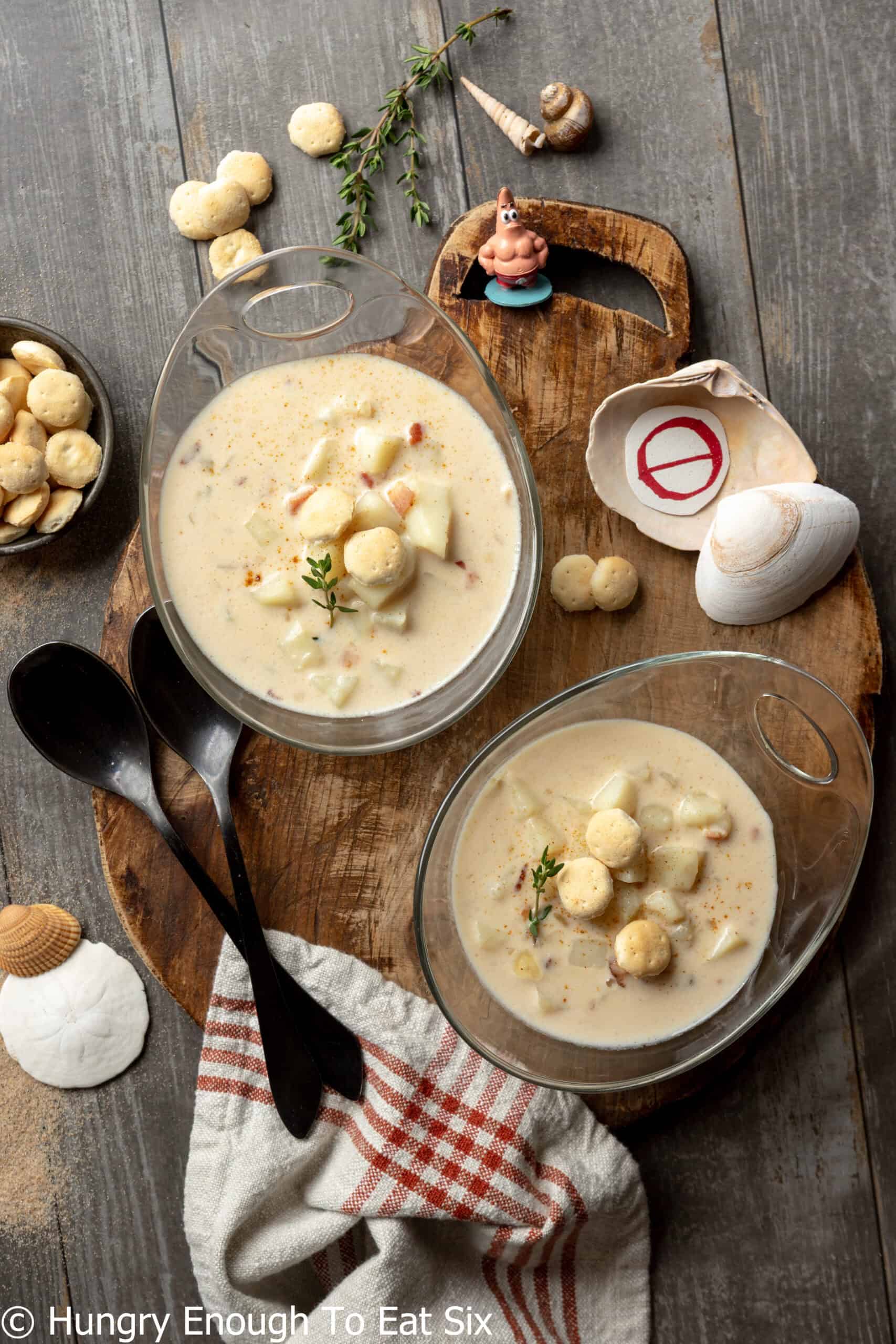
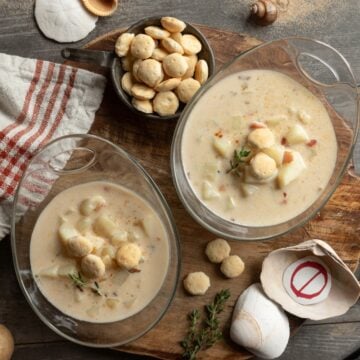
My New England No-Clam Chowder has the savory, milky broth of the traditional dish, and the tender bites of potato, too; just no clams. My family loves this chowder for casual summer meals—don't forget the oyster crackers!
This post contains affiliate links and I may earn a small commission when you click on the links at no additional cost to you. You can read my full disclaimer here.
Here's a perhaps controversial opinion: the very best part of New England's iconic clam chowder is not the clams—it's the broth! And it's this belief (as well as an aversion to clams) that inspired my recipe for New England No-Clam Chowder.
The bowls are brimming with a delectable, savory chowder made with a traditional milky broth, and aromatics like sautéed onion and celery. There are tender diced potatoes in every bite as well. Served with oyster crackers or buttered slices of bread, it's just the perfect summertime lunch.
Leave the clams in the sand, and make a big pot of no-clam chowder instead!
In a nutshell... 🐿️
- What this is: A classic New England-style chowder that skips the clams, but keeps the traditional, milky, savory broth.
- You'll love this part: It's a from-scratch chowder made with pantry staples, delicious for a summer lunch or light dinner. And if you really want the clams, there's an option to add them!
- How it's made: Sauté bacon and aromatics, then simmer diced potatoes until tender. Add 2 kinds of hot milk, then let the chowder cure briefly before serving.
Jump to:
- When I think of New England...
- It's not you, seafood. It's me
- So, why does this chowder have no clams?
- Why you'll love this No-Clam Chowder as much as I do
- 🔪 How to make New England No-Clam Chowder
- What can you serve with New England No-Clam Chowder?
- New England No-Clam Chowder FAQs
- Tips:
- 📖 Recipe
- 💬 Comments
When I think of New England...

Whether you're a native or a visitor, when you think of New England, what comes to mind?
Having grown up here, for me it's so many things: the changing seasons, snow-capped mountains, Red Sox, picturesque towns and quiet downtowns, cows, the colonial and Revolutionary War history, farms, snow boots by the back door, and drives through winding, wooded hills.

Also, locals who are fiercely independent but quick to help others in need, boiling maple syrup, vacations at the ocean, distinctive accents, being a Yankee but rooting against the New York Yankees, ice cream stands, storybook Christmases with family, and warm apple cider donuts.
Have I missed anything? Oh yeah, the seafood... New England's famous seafood!
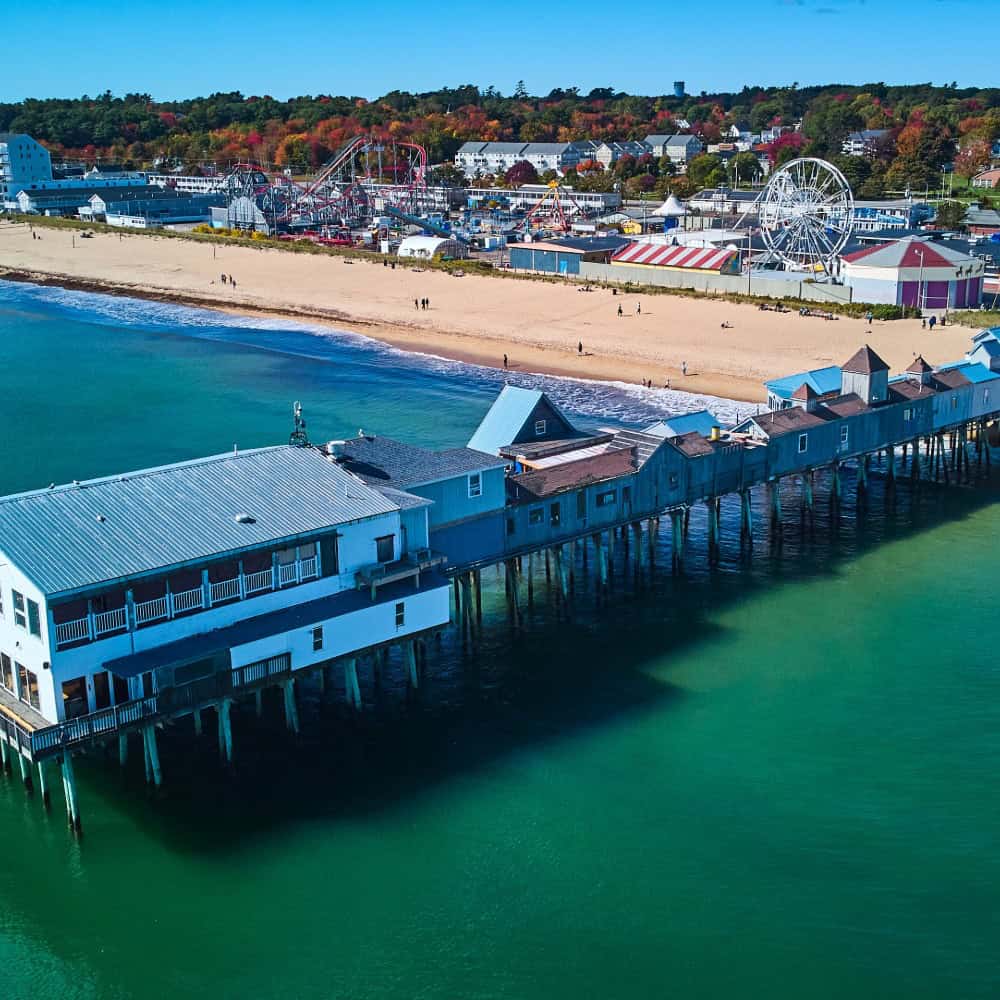
Even though the seashore makes up only about 8% of the total area of New England (with just a smidge of help from New Hampshire and no help from Vermont!), the abundant fish and seafood from our coastal towns means the region is a beloved destination for seafood lovers and home for generations of fishery folk.
Some of the best-loved and most famous New England seafood dishes are boiled lobster, white clam pizza, quahog stuffies, seafood boils, fresh oysters, steamers, lobster rolls, fried clams, fish and chips, and of course, New England clam chowder.
There's just one problem with this seafood side of New England. And to quote Taylor Swift, "it's me."
It's not you, seafood. It's me
Here's a little truth-telling from this lifelong New Englander, my worst-kept secret: I don't like seafood. At all.
It's not a meat thing; I'm a very content carnivore. I've just never, ever enjoyed seafood. (Tuna fish sandwiches don't count.)
I could try to blame the fact that I grew up in landlocked Vermont, but of course there has always been plenty of seafood available in the Green Mountain State. It's shipped in from the coast and boiled, fried, stewed, or baked up everywhere, in cozy kitchens and local restaurants.
Our family has had plenty of summer beach vacations in Maine, where the restaurants and snack bars have far more surf than turf on the menu. No, my aversion is definitely not for lack of access.
I've also had plenty of well-meaning, fish-loving people tell me over the decades that I don't really dislike seafood; I just haven't had it (whether lobster, clams, cod, scallops, shrimp, etc.) made "the right way."
Oh, but I've tried. I really have tried! No matter what it is or how it's prepared, I just don't like the flavor of seafood. Or the aroma. Or the textures.
So, why does this chowder have no clams?
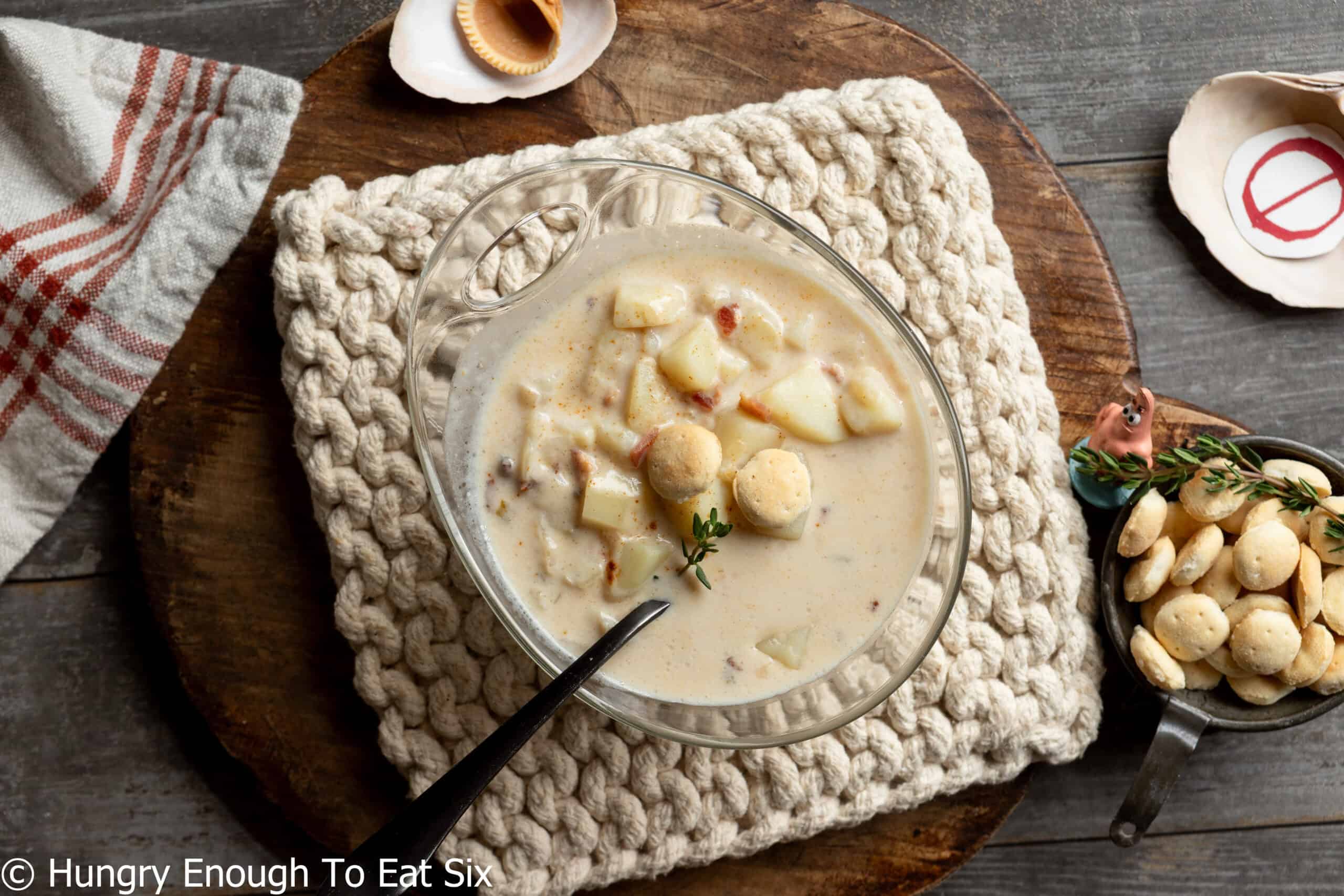
One seafood dish I've been forced to try many a time over the decades is that iconic New England clam chowder.
There were steaming bowls plunked down in front of me against my wishes at the tables of seaside eateries in York and Old Orchard Beach, Maine. Canned clam chowder also occasionally appeared in elementary school lunches, slopped into and down the sides of tiny Styrofoam bowls balanced on the hard plastic trays.
On these occasions, resigned to my fate, I grudgingly ate that dang chowder—but my act of rebellion was to eat only the broth. I deftly avoided the clams and left them behind in a pale, gloopy pile at the bottom of the bowl.
Funny enough, it was in these moments that I realized that clam chowder broth? Well, that's actually very tasty!
In the best versions of those clam chowders, the broth was a little creamy, but milky instead of thick. It had flavor from simple seasonings like diced onions, celery, pepper, and salt. Plus there was a hint of savory, briny flavor in the broth, contributed by the clams. (The umami—though I didn't know that word back then.)
And good chowders also had tender pieces of potato that I could eat with the broth, instead of the wretched clams.
So to make a long story short, (too late), that's what I was thinking about when I created this recipe, and that's why there are no clams in my New England No-Clam Chowder.
I created this dish while thinking about how much the kid version of me would've loved to find a no-clam chowder on the menu at those beachside restaurants in Maine. I would've imagined that they made it just for me, and I would've dubbed it "Nan's No-Clam Chowder"!
Why you'll love this No-Clam Chowder as much as I do
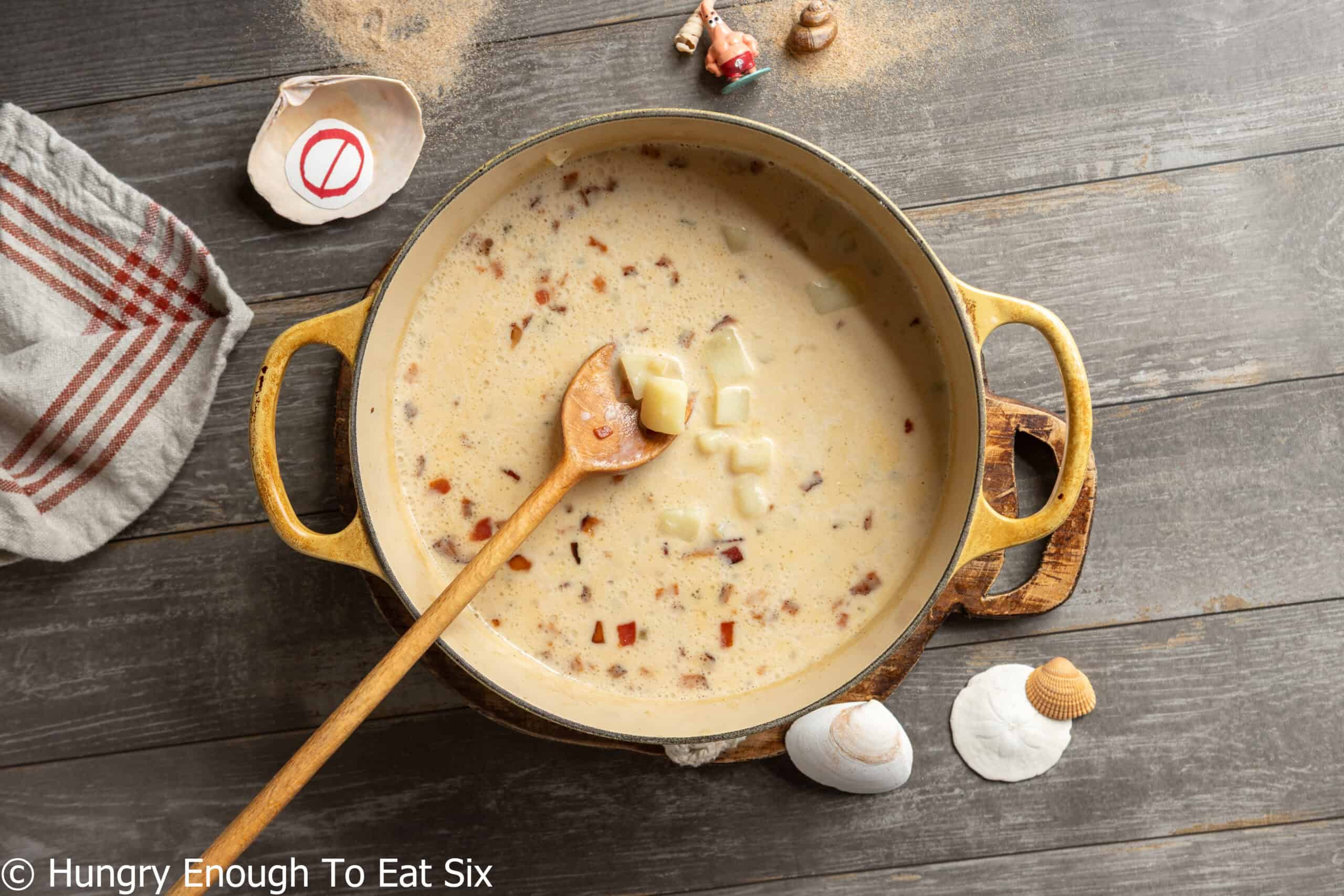
While one way to look at this dish is as a New England clam chowder without the clams, another way to look at it is as a delicious potato chowder! With simple seasonings, tender potato pieces, and a milky broth, this is a wonderful chowder to enjoy for a summer lunch or light summer supper.
And don't just wait for the summer months—make a pot any time of the year. There's nothing like a rich bowl of chowder to warm the bones on chilly fall and winter days.
No-Clam Chowder is straightforward to make using basic pantry and fridge ingredients. The recipe includes a "curing" time, which is a traditional step that I found in nearly every vintage New England clam chowder recipe during my research. Curing means letting the chowder rest for a brief time after it comes off the burner; this allows the flavors to fully develop and also lets the broth thicken up a bit.
This only takes about 30 minutes though, so don't worry—you'll be digging into bowls of this no-clam chowder in no time! Top them with oyster crackers (such as those made by Vermont's Westminster Baker's Company!) or with saltines, or buttered slices of bread. Or, enjoy it they way folks at the New England beachside restaurants do: dunk French fries into the chowder.
And if you're thinking to yourself, "But what if I WANT clams in this chowder??" That's totally fine! Hey, I know that not everyone is hating on seafood like I am. So keep on reading, because I have tips for adding clams in the recipe card and in the FAQs below.
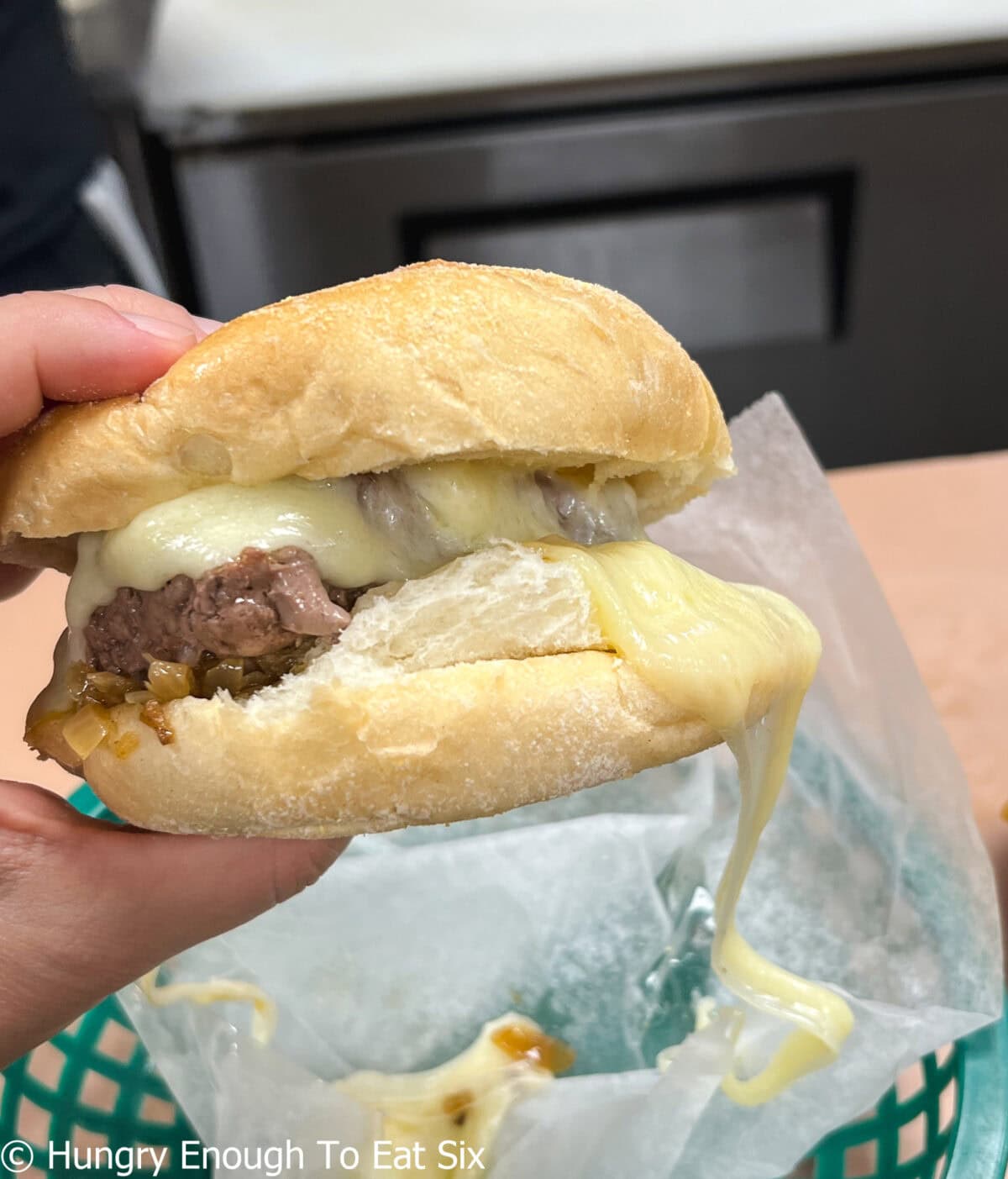
Another New England treat!
Trying Steamed Cheeseburgers
This unique dish is a specialty of Meriden, Connecticut. You've never seen a burger cooked like this before!
🔪 How to make New England No-Clam Chowder
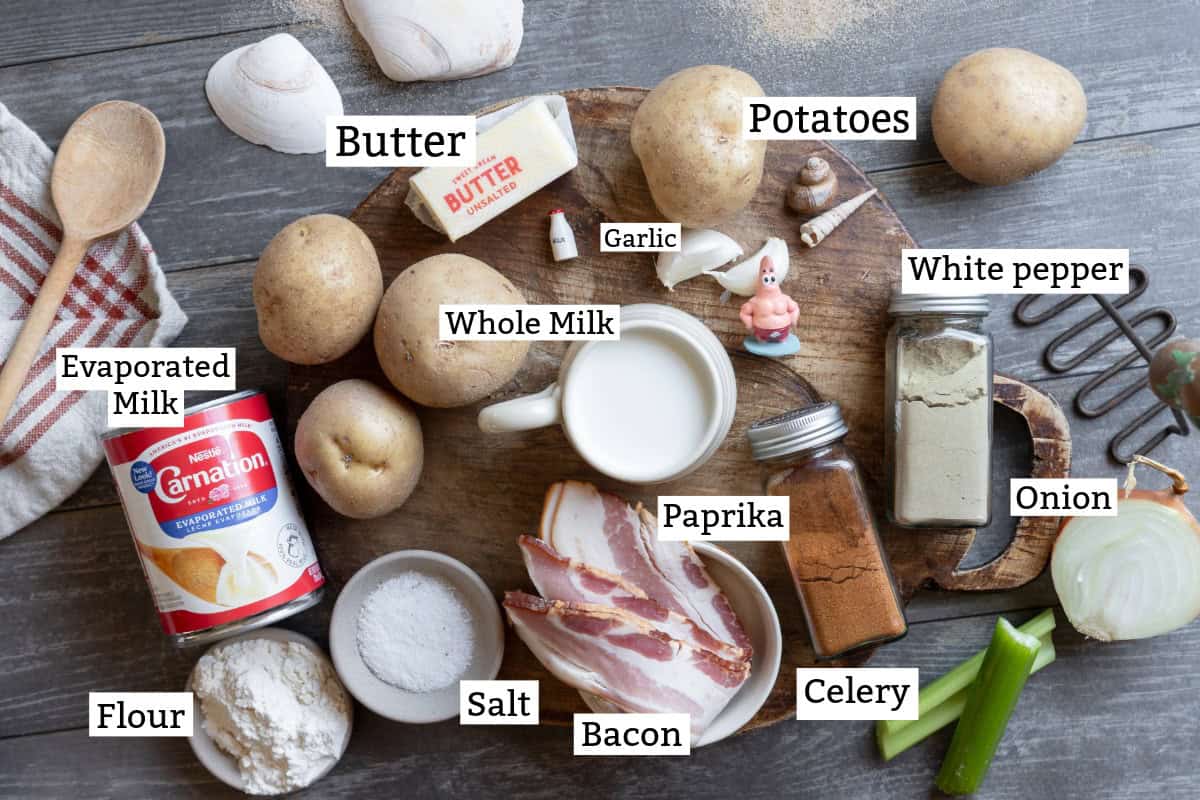
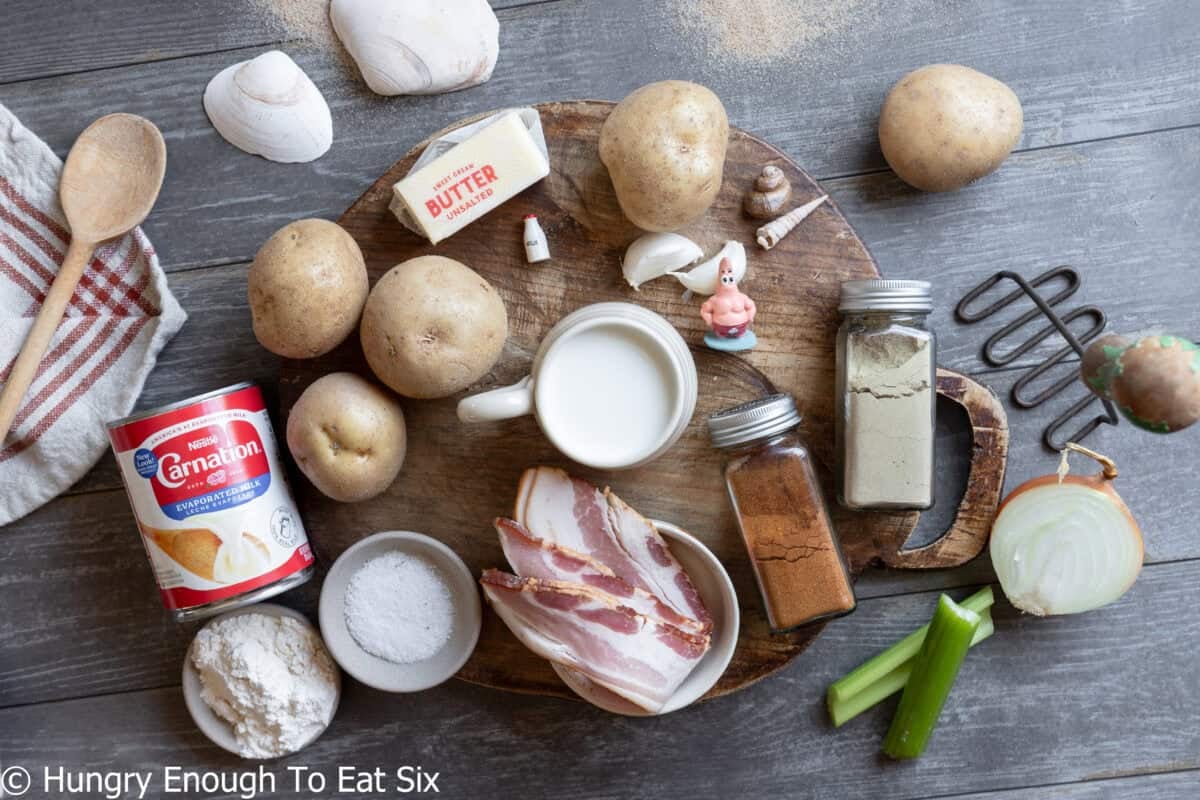
Ingredients:
- Potatoes: Use a waxy type of potato such as Eastern white or Yukon gold. Once cubed and simmered, they hold their shape in the finished chowder.
- Bacon: My favorite brand is New Hampshire's North Country Smokehouse. Some smoky, salty bacon adds flavor and the grease is used to sauté the vegetables.
- Onion, celery, and garlic: These aromatics are sautéed until soft and create the flavorful base of the chowder.
- Butter: Use a good butter in all your dishes for the best flavor. My favorite brands are Cabot, Kate's of Maine, and Ireland's Kerrygold.
- All-purpose flour: Blended with the melted butter, flour becomes a simple roux that helps thicken the broth. My go-to choice is King Arthur All-Purpose Flour.
- Spices: The seasonings in this New England No-Clam Chowder are very basic: salt, black pepper, and a little smoked paprika.
- Whole and evaporated milk: The blend of these two rich types of milk are essential for a traditional New England chowder broth. Look for cans of evaporated milk in the baking aisle. (Don't confuse it with sweetened condensed milk!)
- Soy sauce: I add a dash of soy sauce to give the chowder a little umami and salty flavor that it would normally get from briny clams. It's a background flavor that really elevates the final dish.
SAVE THIS RECIPE OR POST!
Cook the bacon and aromatics
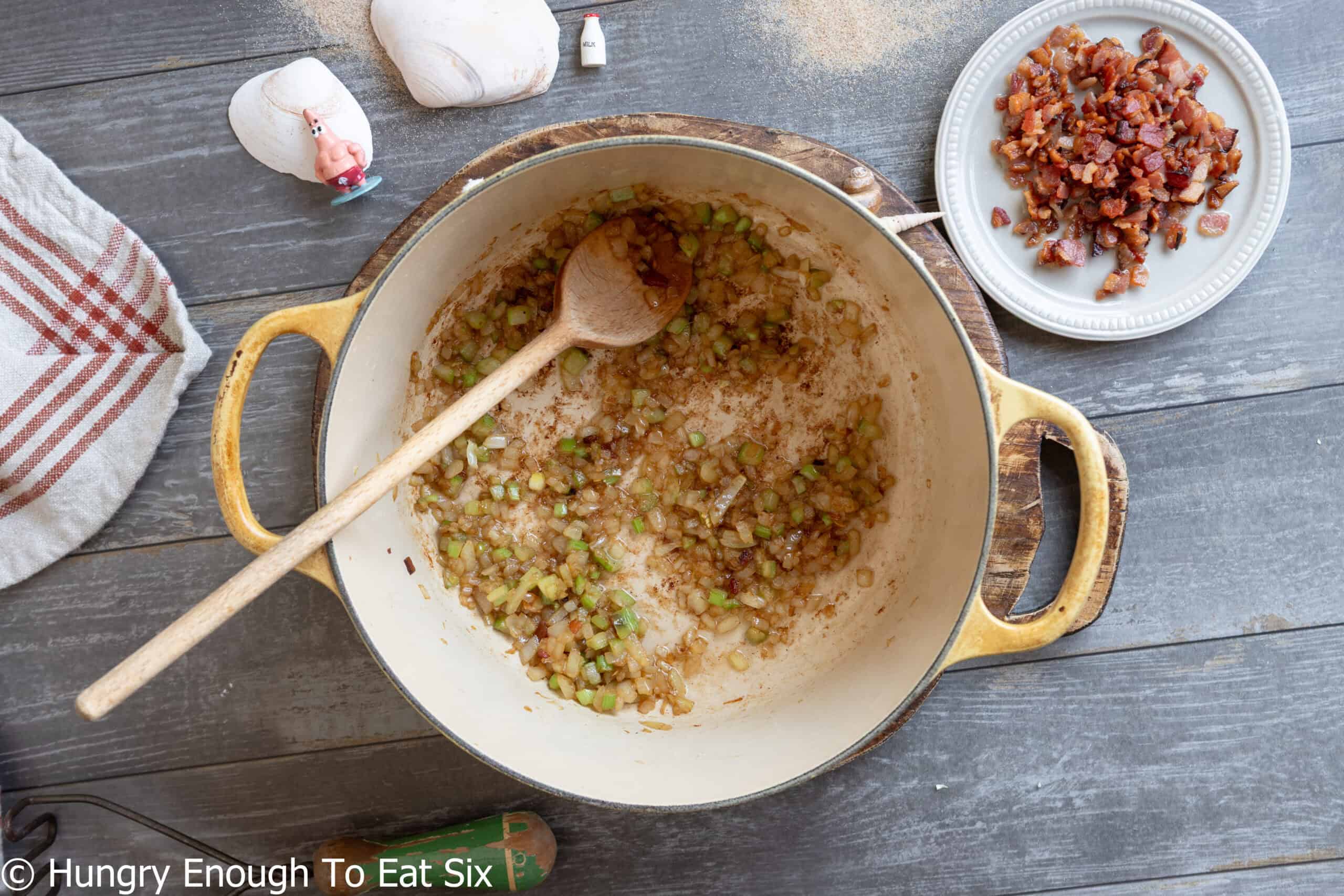
Cook the diced bacon, and then cook up the aromatics in the bacon grease until they're soft.
Then, cook the potatoes
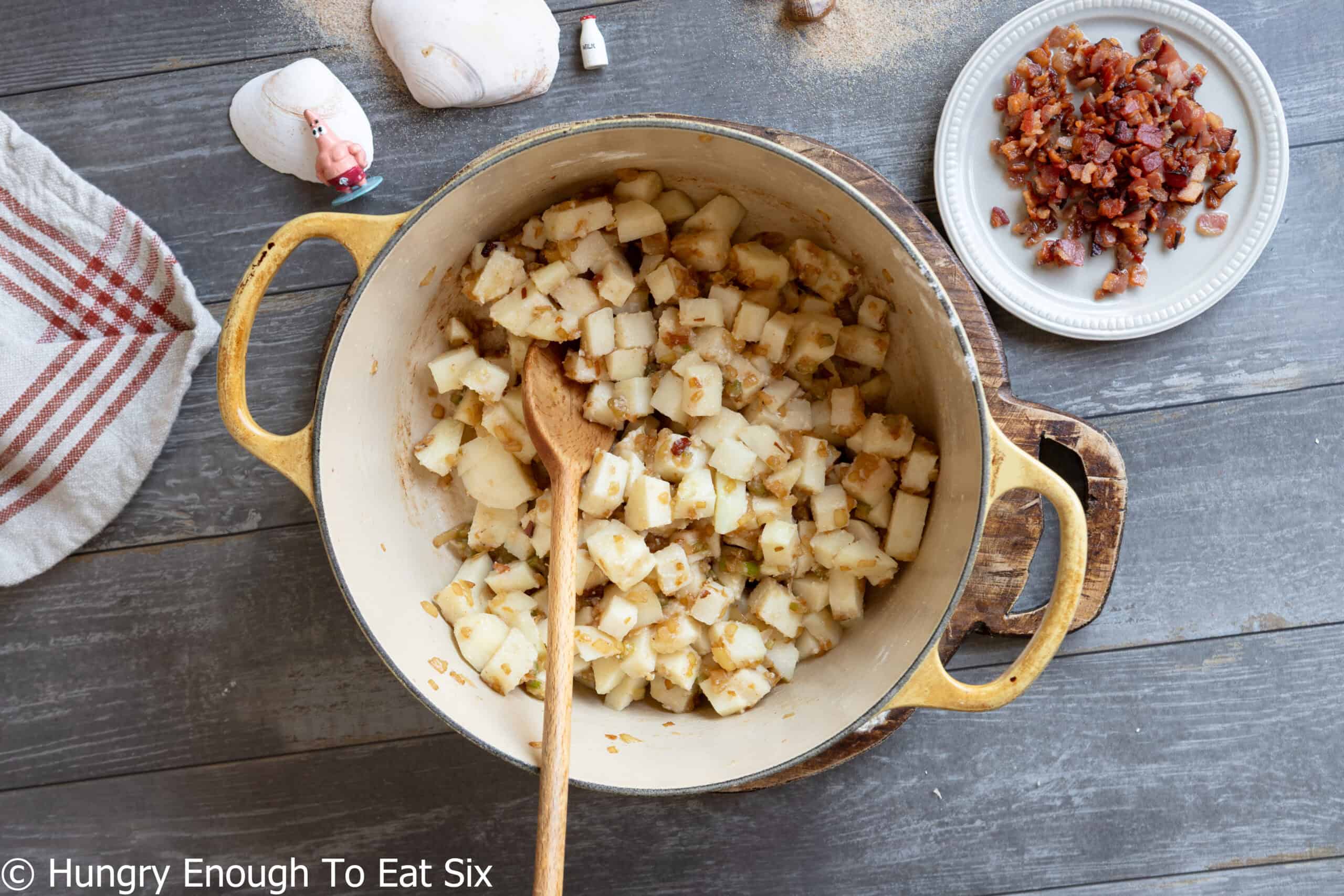
After mixing butter and flour into the pot, add diced potatoes and water. Cook them until they're tender.
Warm the milks
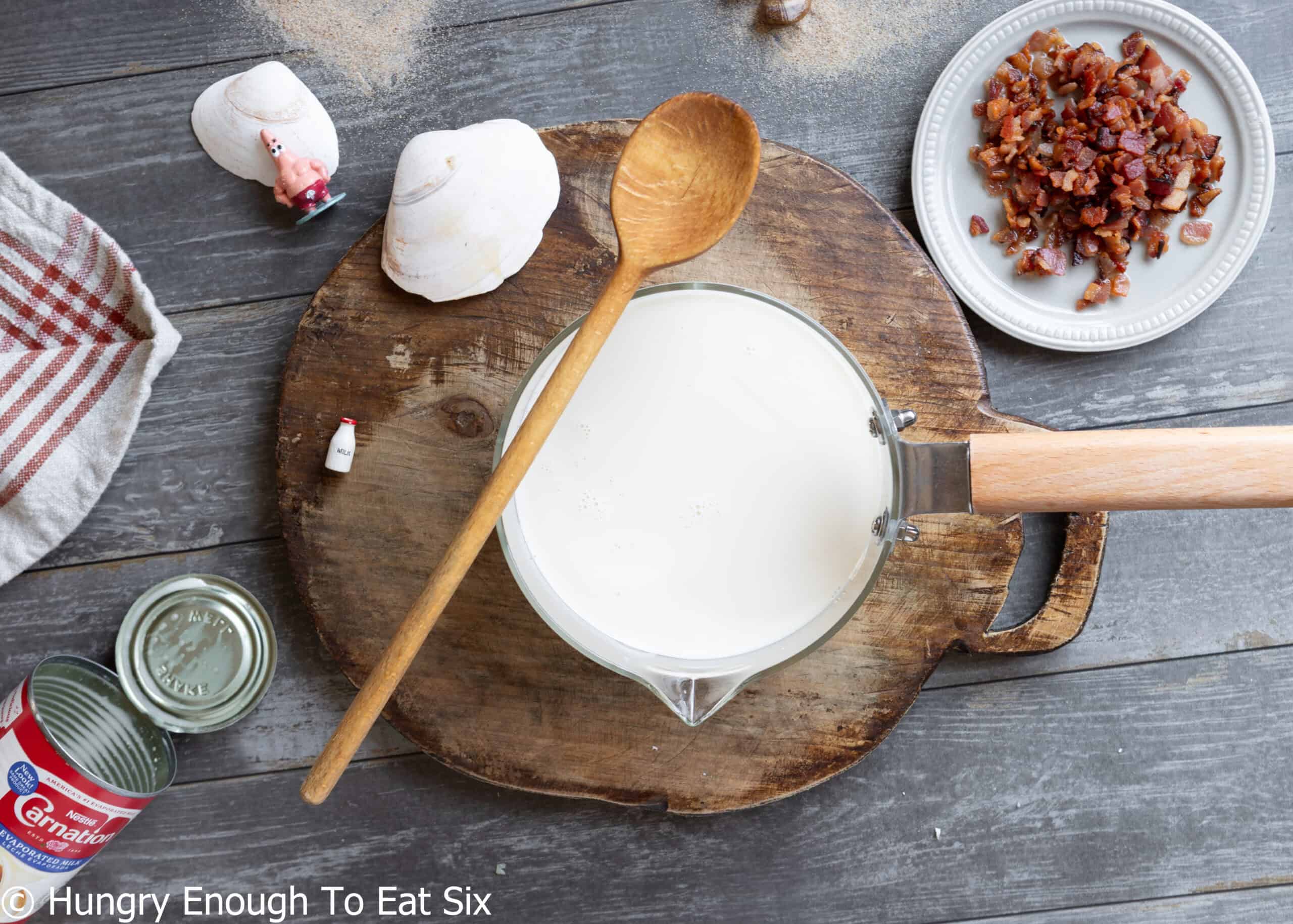
Heat the milks in a saucepan until they're just hot.
Finish the chowder and let it "cure"
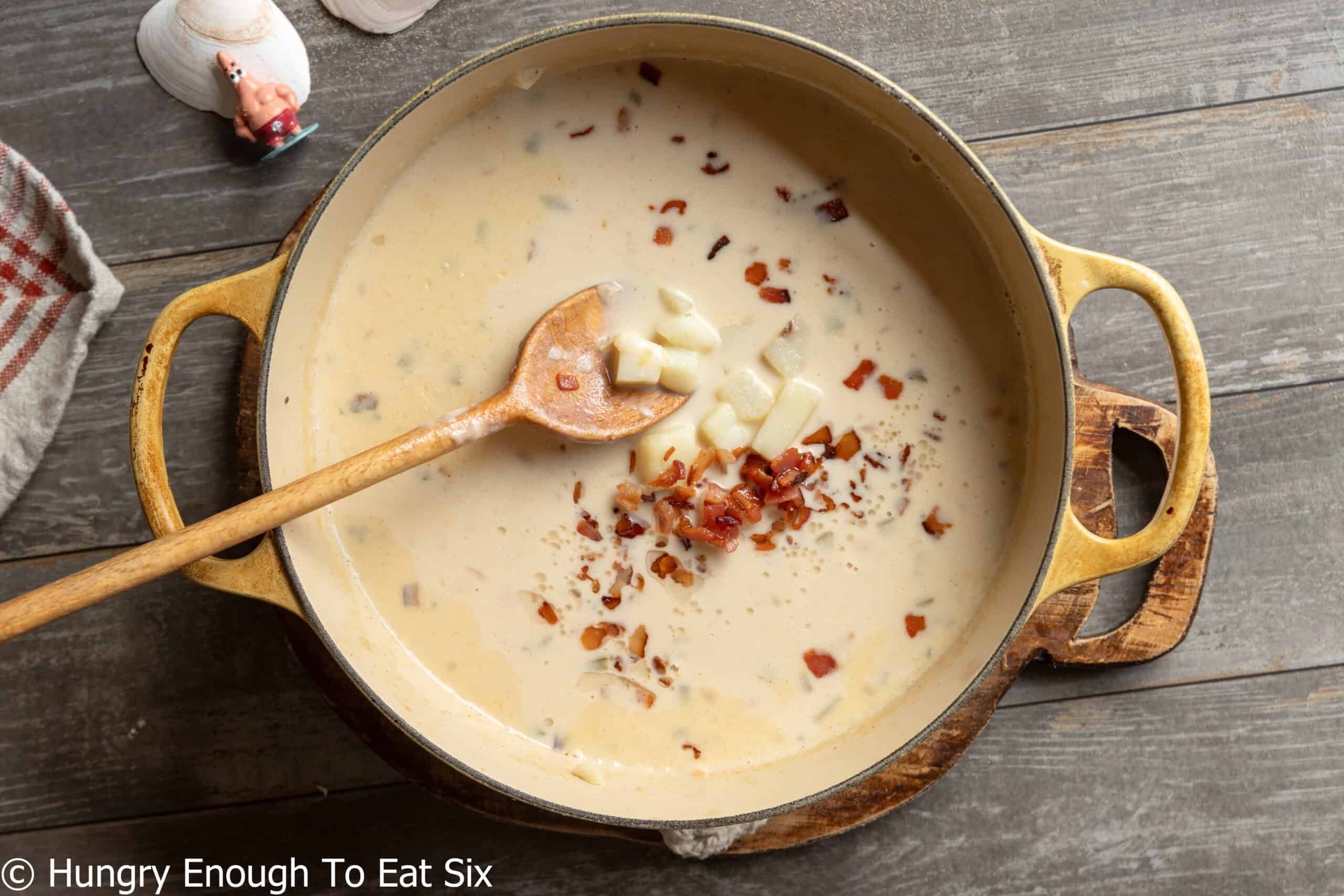
Pour the hot milk mixture into the potatoes and stir everything together, along with the final seasonings. Cover the pot and let the chowder rest off the heat, for 30 minutes to an hour. Then, it's ready to serve.
What can you serve with New England No-Clam Chowder?
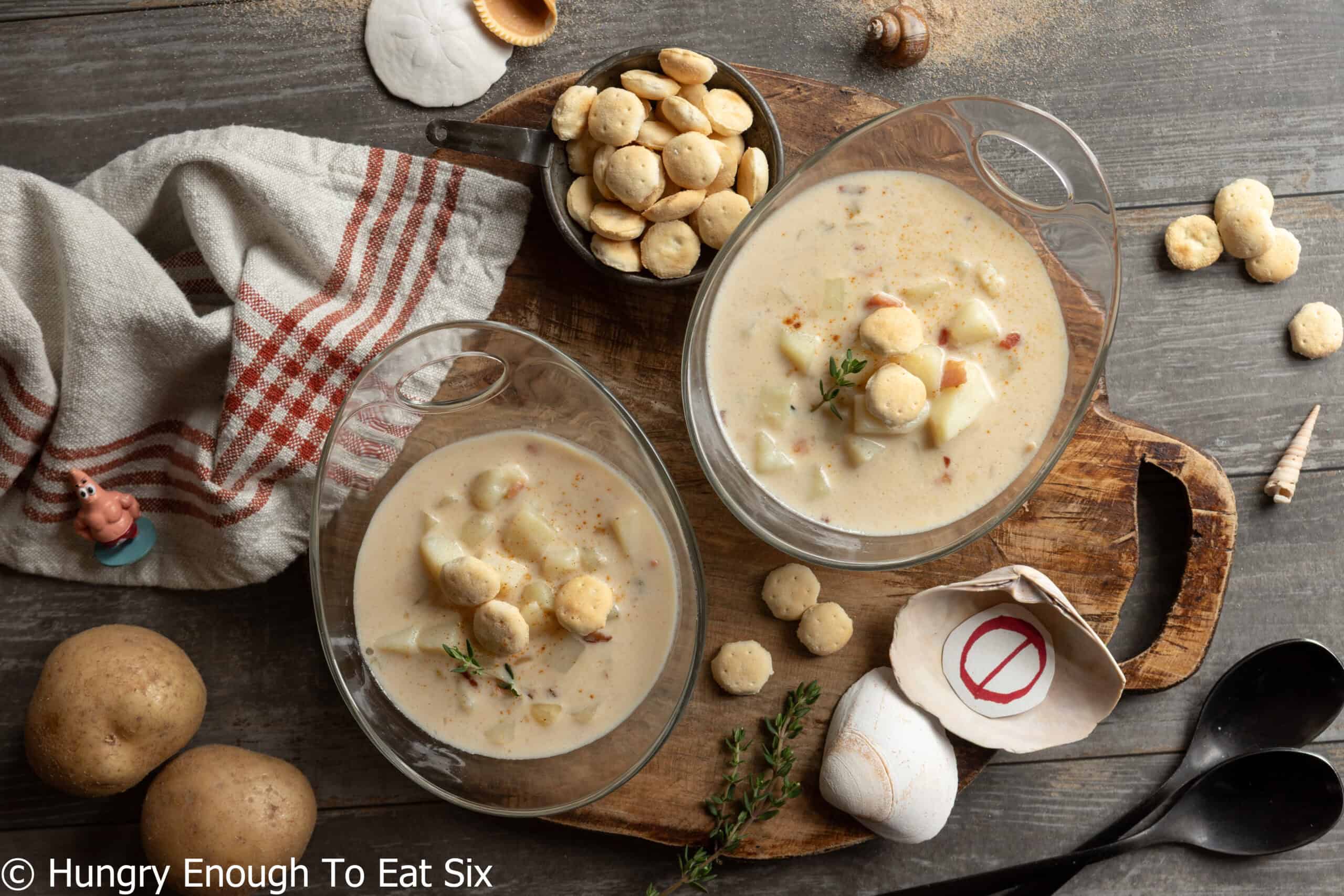
The traditional way to enjoy this chowder with plenty of oyster crackers. Look for the favorite brand, Westminster Baking Company, which was founded in Massachusetts and today operates out of Rutland, Vermont! Oyster crackers can be crushed into the chowder to thicken it, or just sprinkled over the top.
Another crunchy cracker to try is the common cracker, a New England classic that looks like an oversized oyster cracker. Vermont Country Store still makes these the old-fashioned way, and have them in their stores or online.
No-Clam Chowder is also good with saltine crackers, buttered slices of white or sourdough bread, or with a side of French fries to dunk into the broth.
Other toppings and things to enjoy with No-Clam Chowder are chopped fresh herbs like thyme, rosemary, or sage, or buttered scallion biscuits.
New England No-Clam Chowder FAQs
Resting or "curing" is a traditional step in making New England clam chowder, and so it's part of the method to making my New England No-Clam Chowder, too. It simply means leaving the finished chowder off the heat for a short time to rest before serving it. This rest gives the flavors of the ingredients a chance to meld, and allows the broth to thicken a little as well.
Of course you can, hon! This recipe is a classic, milky chowder with savory seasonings and tiny pieces of potato; if you like clams, it's a perfect base to add clams to.
The easiest way to add clams to this chowder is by using inexpensive canned clams. They need only a very brief heat-through; don't overcook them or they will turn tough and rubbery. Add them to the chowder at the same time in the recipe as the hot milks, then let them rest and warm up in the chowder during the curing step.
Fresh clams should also only be cooked a short time. Clean and chop them, and add them to the pot along with the hot milks. Simmer the chowder over medium-low heat for about 5 minutes, then move the pan off the heat and let the chowder cure.
Here is a guide from Serious Eats on the different types of fresh clams; use this to find the best variety to add to your chowder.
If you want to make my No-Clam Chowder with a vegan substitute for clams, this article from Masterclass offers several options—including chopped button or oyster mushrooms, tofu, or beans.
Potatoes fall into categories of starchy, waxy, or all-purpose. Starchy potatoes like russets break down when cooked, but waxy potatoes like Eastern white or red-skinned varieties, keep their shape after cooking. (All-purpose potatoes fall somewhere in the middle.)
I prefer waxy potatoes for this potato chowder, so that the diced pieces can be enjoyed in every bite.
Once it's cool the No-Clam Chowder should be covered and stored in the refrigerator. It will last there for up to five days. Do not freeze this chowder, because it will ruin the texture of the dairy ingredients.
One way to reheat this chowder is in a pot on the stove, with the burner set to medium-low heat. Stir the chowder often until it's heated through.
You can also warm up individual bowls of chowder in the microwave. Zap it in 45-second bursts, stirring after each one, until the chowder is hot.
One way that you can thicken up the broth of my No-Clam Chowder is to mash up some of the cooked potato. Use a slotted spoon to remove some of the cooked potato, mash it well, then stir back into the pot.
Another way is to crush oyster crackers and stir them into your bowl of chowder, where they'll soften and thicken the broth.
New England clam chowder has a white, slightly thickened cream and/or milk-based broth. Manhattan clam chowder, however has a red, tomato-based broth and no cream. It can also have more vegetables and herbs than New England chowder.
There's also the Rhode Island take on clam chowder! This version has no cream either, but instead a clear-ish broth made with clam juice and stock, along with potatoes and veggies like celery and onion. Rhode Island clam chowder is made with quahogs, the favorite shellfish of the Ocean State.

A summery side!
Syracuse Salt Potatoes
This 2-ingredient recipe is a favorite in upstate New York, and the tastiest side to enjoy at backyard cookouts or seaside clambakes.
Tips:
- Resting or curing is a traditional step in making New England chowder, one that gives the flavors in the pot a chance to meld. It also lets the broth thicken a bit more before serving.
I'd like to thank the young me for braving those unwanted bowls of New England clam chowder all those years ago. Young me, without your brave sacrifice, we never would have discovered this delectable way to enjoy just the chowder broth and potatoes without all those clams getting in the way!

My recipe for New England No-Clam Chowder is below. Here are more New England inspired recipes to try, too!

💬 Did you make and devour this recipe? Leave a comment below.
📖 Recipe
New England No-Clam Chowder
SAVE THIS RECIPE OR POST!
Ingredients
- 4 strips bacon, diced
- 1 cup diced onion (from about 1 medium onion)
- ¼ cup diced celery
- 1 clove garlic, minced
- 2 tablespoons butter
- 4 cups diced white or yellow potatoes (about 1½ pounds whole potatoes)
- ¼ cup all-purpose flour
- 1½ teaspoon salt, divided
- ¾ teaspoon white pepper, divided
- water to cover the potatoes
- 2 cups whole milk
- 2 cups evaporated milk
- 1 teaspoon soy sauce
- ¼ teaspoon smoked paprika
Instructions
Cook the bacon and aromatics:
- Add the 4 strips bacon, diced to a large Dutch oven or soup pot set over medium-high heat. Cook and stir the bacon until it's browned and crisp.
- Use a slotted spoon to remove the bacon from the pot; hold the bacon aside.
- Add the 1 cup diced onion and ¼ cup diced celery to the bacon fat in the pot. Stir and sauté the vegetables for about five minutes, until they're softened. Stir in the 1 clove garlic, minced and sauté the mixture for one minute longer.
Cook the potatoes:
- Stir 2 tablespoons butter into the pot. Once it's melted, add the 4 cups diced white or yellow potatoes, ¼ cup all-purpose flour, 1 teaspoon of the salt, and ½ teaspoon of the white pepper to the pot; stir until the potatoes are coated with the flour and spices.
- Add just enough water to cover the potatoes in the pot.
- Increase the heat to bring the water to a simmer. Then, reduce the heat to medium and cover the pot. Cook the potatoes for about 10 minutes until they're tender when pierced with a fork.
Meanwhile, warm up the milks:
- While the potatoes cook, pour 2 cups whole milk and 2 cups evaporated milk into a medium saucepan. Set the pan over medium heat.
- Warm up the milks, stirring often to prevent them from burning on the bottom. Once the milks are hot, remove the pan from the burner. (The mixture should be hot, but not boiling.)
Finish the chowder:
- Remove the lid from the pot once the potatoes are done.
- Slowly whisk the hot milk mixture into the pot with the potatoes. Stir in 1 teaspoon soy sauce, ¼ teaspoon smoked paprika, the remaining salt, and the remaining white pepper.
Let it "cure":
- Move the chowder off the heat, cover the pot and let the chowder rest, or cure, for at least 30 minutes or for as long as an hour.
- (Resting or curing the chowder gives the flavors a chance to meld and let's the broth thicken a bit more.)
Serve:
- Ladle the no-clam chowder into soup crocks or bowls. Add a dash of salt and black pepper to season to taste. Serve plenty of oyster crackers with the chowder, too! They can be crushed into the chowder to thicken it, or just sprinkled over the top.
- Other toppings and things to enjoy with No-Clam Chowder are chopped fresh herbs like thyme, rosemary, or sage, saltine crackers, slices of buttered sourdough bread, or scallion biscuits.
To add clams to the chowder:
- The easiest way to add clams to this chowder is by using inexpensive canned clams. They need only a very brief heat-through; don't overcook them or they will turn tough and rubbery. Add them to the chowder at the same time in the recipe as the hot milks, then let them rest and warm up in the chowder during the curing step.
- Fresh clams should also only be cooked a short time. Clean and chop them, and add them to the pot along with the hot milks. Simmer the chowder over medium-low heat for about 5 minutes, then move the pan off the heat and let the chowder cure.
- Here is a guide from Serious Eats on the different types of fresh clams; use this to find the best variety to add to your chowder.
Notes
- Resting or curing is a traditional step in making New England chowder, one that gives the flavors in the pot a chance to meld. It also let's the broth thicken a bit more before serving.
Nutrition

Anonymous says
This is the kind of soup that makes you want a second bowl! So tasty!
Nancy Mock says
I'm so glad you enjoyed it, thanks for the great feedback!